
Step 1
Overhead Guru
Clean the P&L, verify billable hours and calculate the overhead each productive hour must recover.
For project-driven companies that quote jobs and run crews
Know what every labour hour must recover before the quote leaves your hands. Once the customer accepts the price, labour costs your rate missed must be absorbed somewhere—often from the profit you expected to keep.
One-time purchase · Digital training, worksheets and quote tools
The quote is the last safe place to correct the rate
An incomplete labour rate repeats across every hour on the job. Test the potential exposure before the quote becomes a commitment—and before delays, rework or unbilled changes create additional pressure.
Illustration uses historical planning standards from the reference calculator to estimate labour burden, overhead burden and 1,500 productive hours per employee. The example models the three constant cost layers: base wage, labour burden and overhead burden. When the labour value used in the quote equals the charge-out rate, the calculator treats that number as a selling rate with 25% profit included and removes the margin before comparing costs. It is not a diagnosis of your actual costs and does not predict or guarantee a financial result.
A number is not the same as a verified number
The wage is where the calculation starts. It is not where the calculation ends.
The mechanism
The Blueprint separates the layers so every cost has one proper home—never skipped and never counted twice.
True labour cost is the floor your selling price must clear before the job can produce profit.
Three guided calculations
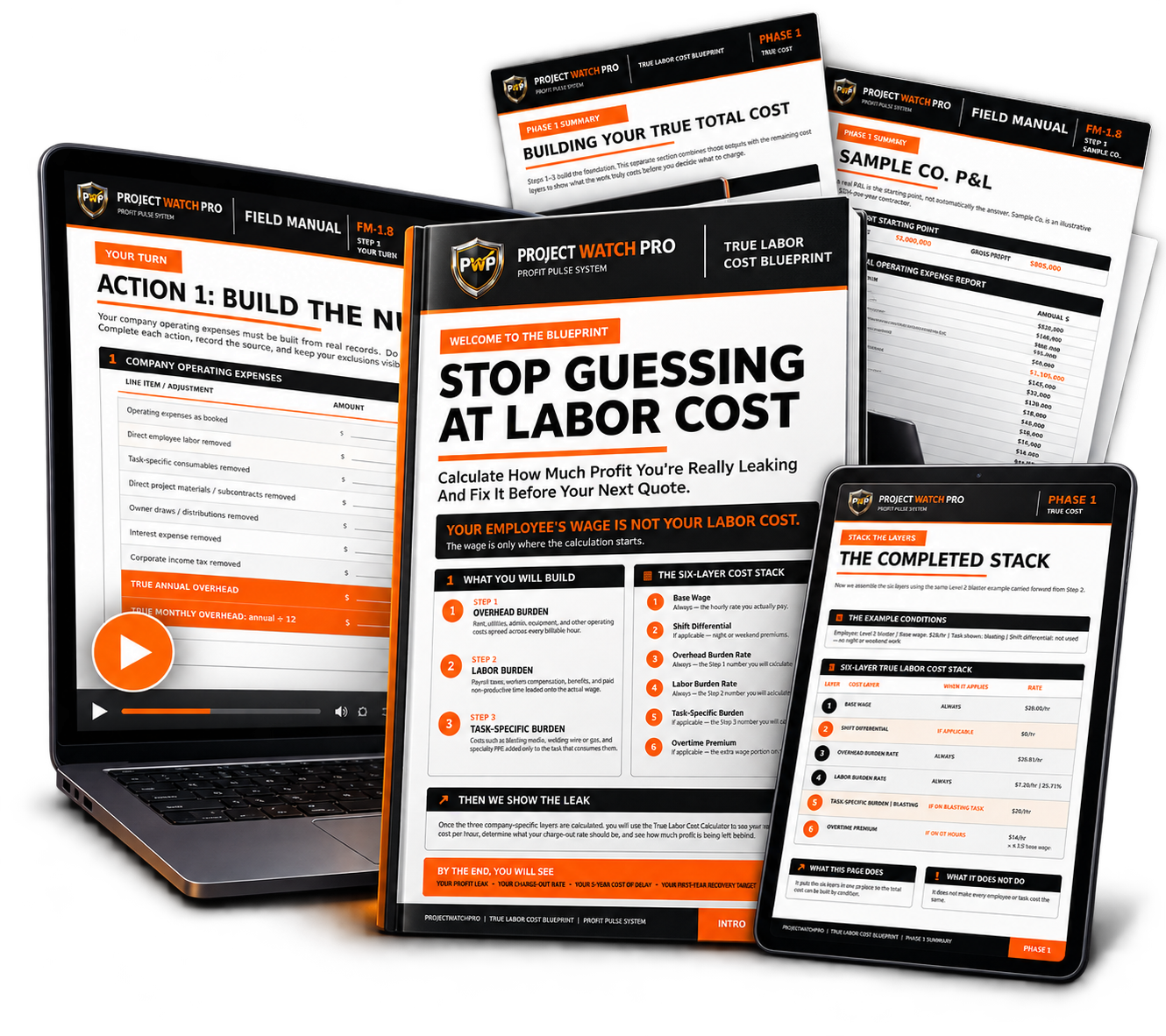
Every page has a short walkthrough so you can learn one decision, complete the corresponding work, and carry the verified result forward.
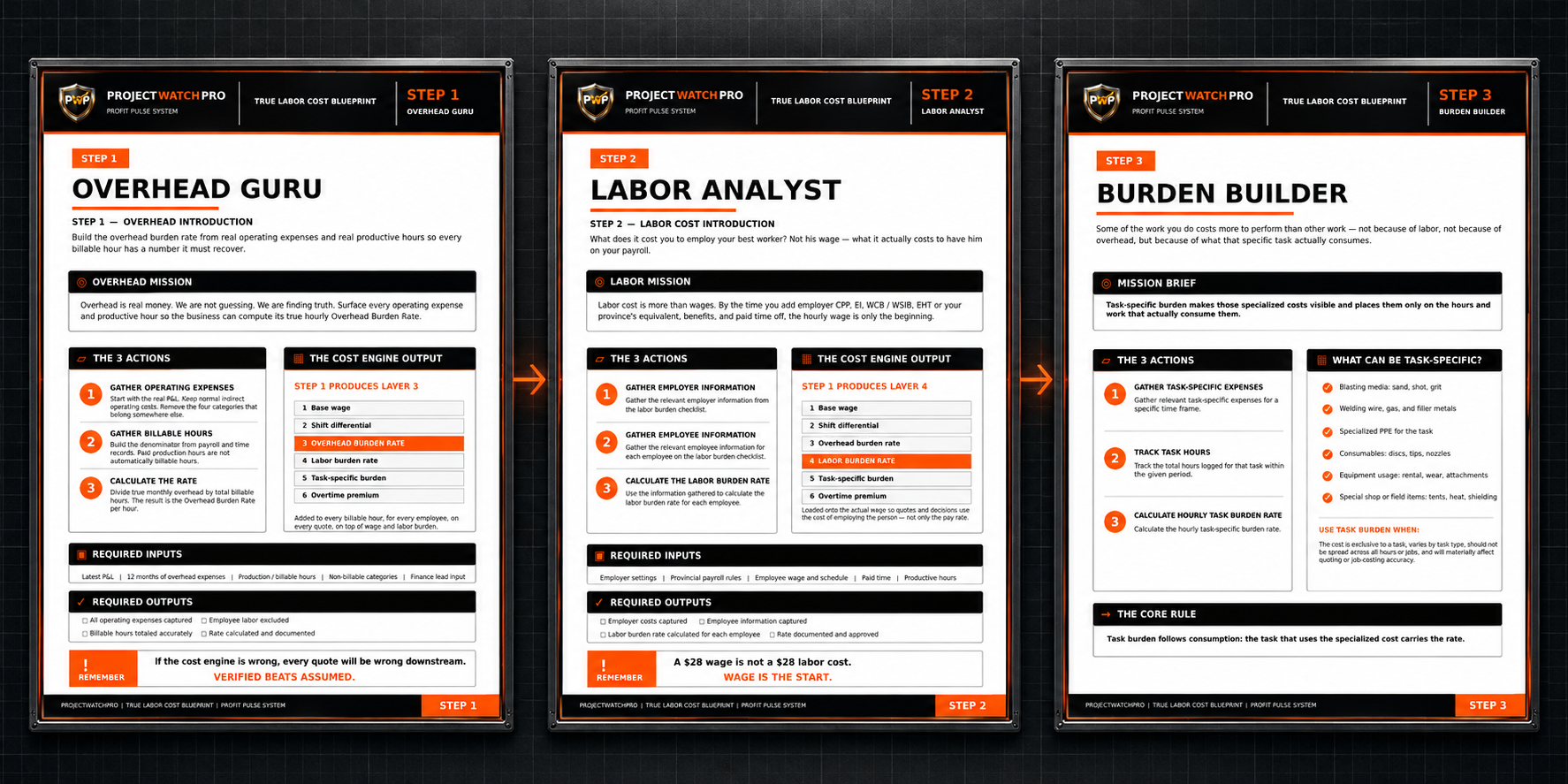
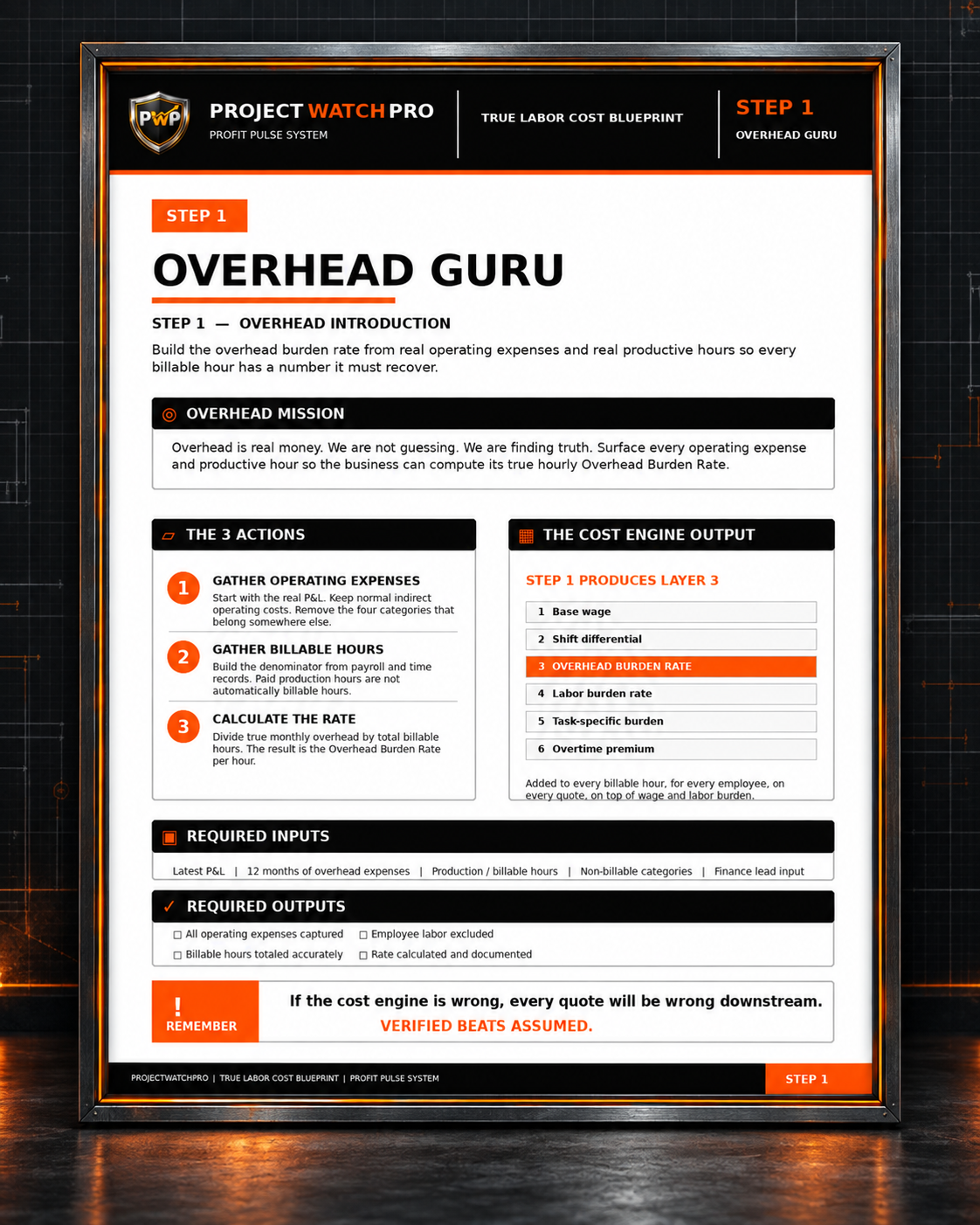
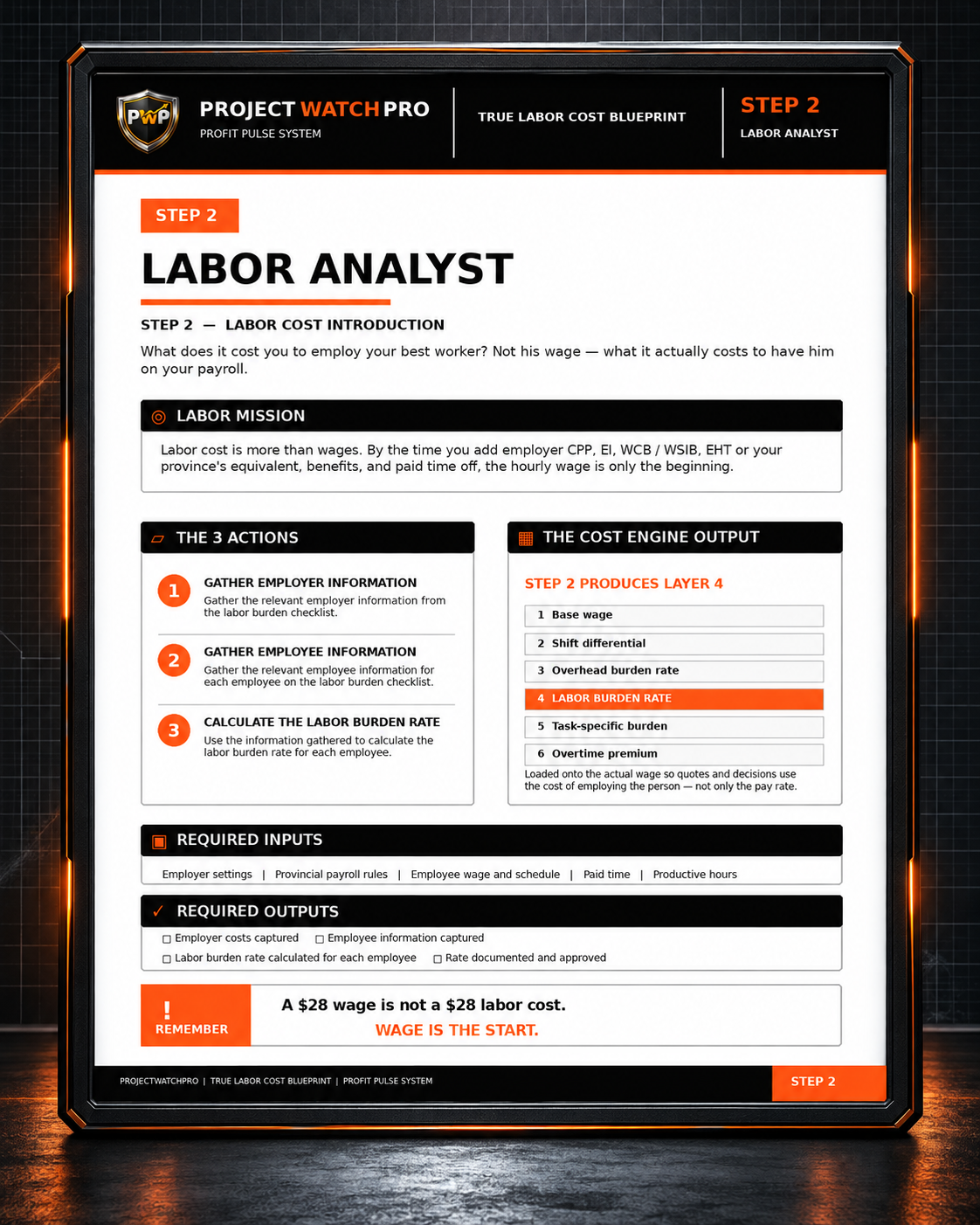
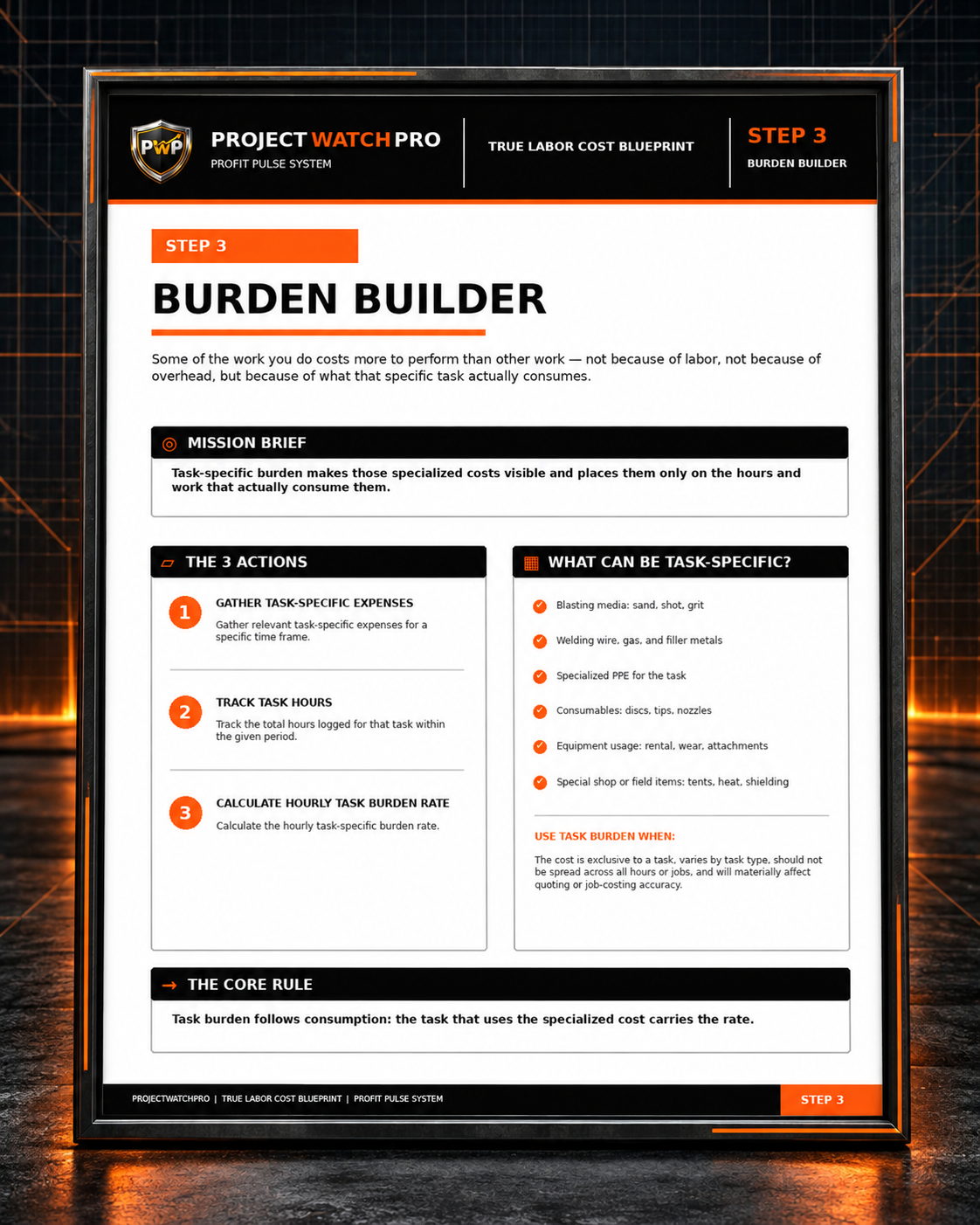
Step 1
Clean the P&L, verify billable hours and calculate the overhead each productive hour must recover.
Step 2
Load employer costs and paid time onto actual productive hours to calculate what each employee really costs.
Step 3
Match specialized costs with the tasks and hours that consume them instead of burying them in one flat rate.
Built for operators—not accountants
You do not need to master accounting theory or rebuild your entire operation. The walkthroughs show you what belongs in each calculation, what must be removed and how to avoid counting the same cost twice.
Start with your current P&L, payroll information, paid-time policies and productive-hour records.
Each practical 1–2 minute video explains one decision and the corresponding worksheet action.
Verify each company-specific rate, assemble the six applicable layers and carry the result into an upcoming quote.
Illustrative worked example
The six-layer stack shows exactly how the applicable costs accumulate for this employee, task and overtime scenario.
Some layers always apply. Others apply only when the shift, task or overtime conditions trigger them.
The point: the wage is only the first layer of the labour cost carried into the quote.
Illustrative company conditions from the course example. These figures are not universal rates or promised results.
What the math exposed in real businesses
Each example illustrates a different reason to verify the number before it is repeated across another quote.
John reports that correcting the rate contributed to $50,000 in additional profit during the first month. The company has reportedly used the method since 2004.
A single $110 flat rate was being used across the business while true regular employee cost was already above $100 per hour. The calculation showed only one task was profitable at that rate.
The review reportedly found that quoted work was $35 per hour short of covering true labour cost plus the intended margin, while some subcontract work was capped at approximately true cost.
These historical ProjectWatchPRO client examples reflect company-specific conditions. They are not typical results, independently audited claims or guarantees of what another company will achieve.

Knowing the cost is only useful if it reaches the quote
The Blueprint builds the numbers. The included worksheets and Excel tools help carry those verified costs and your intended profit into the next quote.
Do the work—not just the watching
Bring your current P&L, payroll information, paid-time policies and productive-hour records.
Use each short walkthrough to understand what belongs, what must be removed, and why.
Complete the worksheets and tools using your company’s actual numbers and assumptions.
Carry the verified rates into the Bulletproof Quote worksheets and test an upcoming quote.
Your complete working package
Built for the way your company works
Use it when labour, overhead and task costs must be recovered through the jobs your company sells.
Best fit: an operating company with access to basic P&L, payroll and time information. This is not a generic wage survey or a substitute for professional tax, payroll or accounting advice.

Why this system exists
Most contractors do not intend to quote bad work. They lose profit because the number used to build the quote was incomplete, the specialized costs were spread incorrectly, or the final report arrived after the crew had moved on.
John A. McCabe developed the Profit Pulse System to connect the numbers used in the quote with the work performed in the field. The True Labor Cost Blueprint teaches the three foundational calculations that the later quoting, scheduling and profit-control steps depend on.
This is not accounting theory. It is a practical way to show what every productive hour must recover before the company can earn profit.
Check the number before you repeat it
One incomplete rate repeated across one job could expose hundreds or thousands of times more than the price of the Blueprint.
Questions before you begin
The Blueprint calculates the cost foundation behind the labour in your quote. The included Bulletproof Quote System helps carry those costs, other quote inputs and your intended profit into a proposed selling price. Market conditions and management decisions still determine the final price.
No. True labour cost is the cost the selling price must first recover. Profit is built above the applicable costs. A rate that only recovers true cost leaves no profit for that labour.
No. The training explains what information is needed, what belongs in each calculation and what must be removed. You will need access to accurate company records, and you may involve your bookkeeper, payroll provider or accountant when confirming inputs.
Bring your current P&L, approximately 12 months of operating expenses, payroll and employer-cost information, paid-time policies, productive or billable hours, and records for any task-specific expenses you want to calculate.
The calculation method applies broadly, but payroll taxes, workers’ compensation, pensions, benefits and other employer costs vary by jurisdiction. The course includes regional reference examples, and you must confirm the current rates and rules that apply to your company.
No. Base wage, overhead burden and labour burden are the always-on foundation in the course model. Shift differential, task-specific burden and overtime premium apply only when the relevant condition occurs.
No. You can complete the Blueprint and quote worksheets independently. ProjectWatchPRO is the software platform built around the broader Profit Pulse System, but it is not required to use this training package.
No. This package teaches the three True Cost Foundation steps. The complete system continues into task planning, quoting, scheduling, live job visibility, profit-drift correction and continuous improvement.
Before the next quote becomes the next job
Calculate the three company-specific burden rates, assemble the complete six-layer labour cost, and carry the verified number into the quote before the price is accepted.
One-time purchase · Replace the checkout placeholder when the GHL order page is ready.